

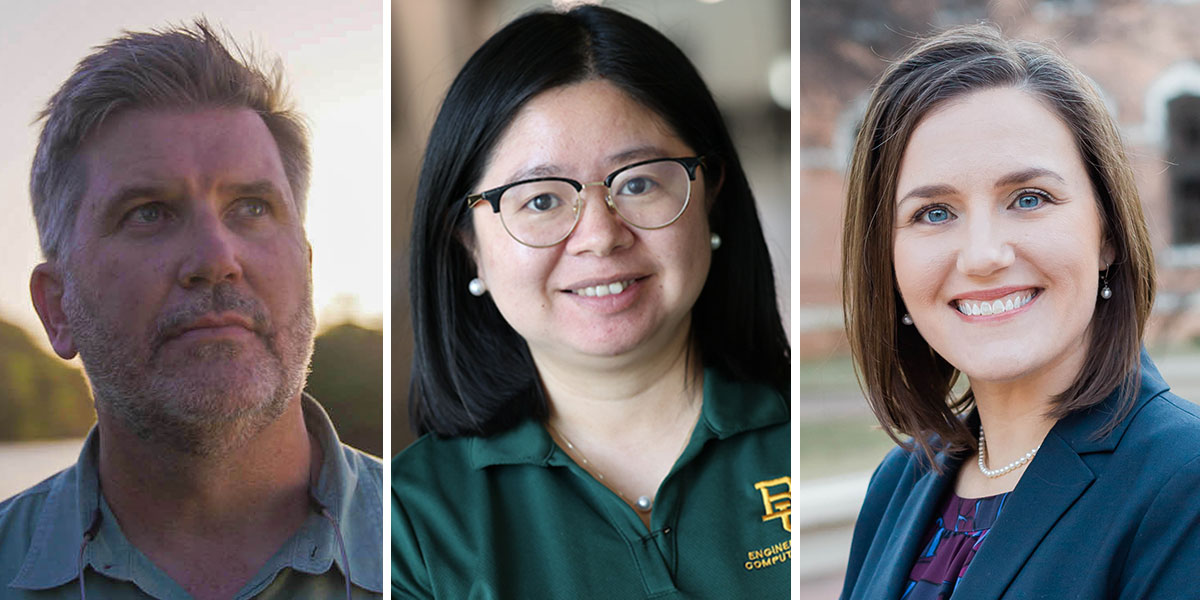
As Texas communities continue to grow, Baylor researcher Ryan McManamay is helping leaders, landowners and residents envision what that growth could mean for the resources, landscapes and communities that make Texas distinct.
What could communities accomplish if they could go beyond mere measurement of water usage and treatment and delve inside the data for true insight? Mandy Hering applies elite statistical science research to help them do just that.
Bryan Brooks has demonstrated that data in the water is a tool to protect public health. His work in wastewater epidemiology and "forever chemical" studies helps communities take proactive measures to serve their citizens.
Humans cannot flourish without water. Thad Scott's research helps states and communities navigate water challenges, plan for the future and meet the needs of water consumers to come.
When you turn the faucet, you expect clean water to pour out. Baylor researchers Bryan Brooks and Thad Scott examine current and future challenges to water quality and availability, and demonstrate how Baylor has become an internationally trusted leader in water quality research.
In 2022, a dramatic rainstorm became a generational challenge at Yellowstone National Park. For Ryan McManamay, this disruption was an opportunity to advocate for communities impacted by the critical infrastructure natural resources provide.
Dr. Amanda Hering applies her statistical expertise to a “once in a generation effort” to improve water treatment in the U.S. Hering, associate professor of statistical science, is an internationally-recognized leader in data sciences and their intersection with the environment.
Mandy Hering's statistical science expertise addresses global needs and supports municipal water systems across the country. Discover how the Baylor mission and statistics intersect to protect water resources for the future.
Where can community leaders and policymakers get the information they need to serve water needs in their area? Researchers like Thad Scott provide them the tools to make effective and efficient use of our natural resources.
Communities are searching for new, efficient ways to deliver clean water to their residents. Statistical scientist Mandy Hering applies her discipline to advance water research in innovative ways.
How can communities plan for future growth amidst the pressing challenges and opportunities of current expansion? Ryan McManamay has built data-driven tools to help them do just that.
Baylor researchers Bryan Brooks and Thad Scott examine challenges to water quality and availability, and demonstrate how Baylor has become a trusted leader in water quality research.
An internationally recognized leader in clean water research, Bryan Brooks addresses emerging challenges to clean water delivery close to home and around the globe.
Mandy Hering partners with municipalities and the Department of Energy, employing data-driven methods to address both long-term and acute challenges to clean water delivery.
Decisions made now will impact future generations' access to water. Baylor limnologist Thad Scott provides the information needed to make wise choices today.
When flooding in Yellowstone stalled a family vacation, Ryan McManamay turned his attention to those impacted by disaster. Here, he tells that story and shares a vision for natural resources as critical infrastructure.
Mandy Hering has applied statistical expertise to a “once in a generation effort” to improve water treatment in the U.S., and shares how data yields new paradigms of water treatment.
Bryan W. Brooks, Ph.D., has been elected an AAAS Fellow by the American Association for the Advancement of Science.
A journey into the world of data sciences at Baylor University, from disciplines like statistical science, computer science, public health, information systems, Biblical studies and more.
Related Stories
summary text goes here